Found a jar of old or foreign coins? How to identify them, what makes a coin valuable, where to check real prices and when grading is worth it.
Almost everyone ends up with a few mystery coins: a tin from a grandparent, change left over from a trip, a coin that turned up in a drawer. The first question is always the same. Is it worth anything?
The honest answer is that most coins are worth about face value, or a little more to a collector. But some are worth a lot more, and you can find out which kind you have without paying anyone. Here's how.
The short answer
A coin's value comes down to four things: how rare it is, what condition it's in, what it's made of and how many people want it. To estimate it, identify the coin exactly (country, denomination, year and any mint mark), judge its condition honestly, then look up recent sold prices for that coin in that condition.
Step 1: Identify the coin exactly
Write down everything printed on it:
Country.
Not always in English. "Helvetia" is Switzerland, "Magyarország" is Hungary, "Suomi" is Finland.
Denomination.
10 pfennig, 5 baisa, 1 rupee.
Year.
Some coins use other calendars. Thai coins use the Buddhist era (543 years ahead of the Western year), and some older Middle Eastern coins use the Islamic calendar.
Mint mark.
A small letter or symbol that shows where it was made. On US coins, a "D" or "S" can change the value a lot.
Then look it up. For world coins, Numista is a free online catalogue where you can search by country and denomination or by the text on the coin, and it shows mintages and typical values. For US coins, the Red Book (A Guide Book of United States Coins) is the standard reference. For world coins in print, there's the Standard Catalog of World Coins.
Step 2: Understand what makes a coin valuable
Rarity
Rarity starts with mintage, the number of coins made that year. A coin with a mintage of a few thousand is far scarcer than one with hundreds of millions. But survival matters too: a common coin from 1890 may be rare today because most were worn out, melted or lost.
Condition
Condition is often the biggest factor. The same coin can be worth a few dollars worn smooth and hundreds in sharp, unworn condition. Collectors describe condition on a 1 to 70 scale. Our guide to coin grading explains what grades like MS-65 and VF-20 mean.
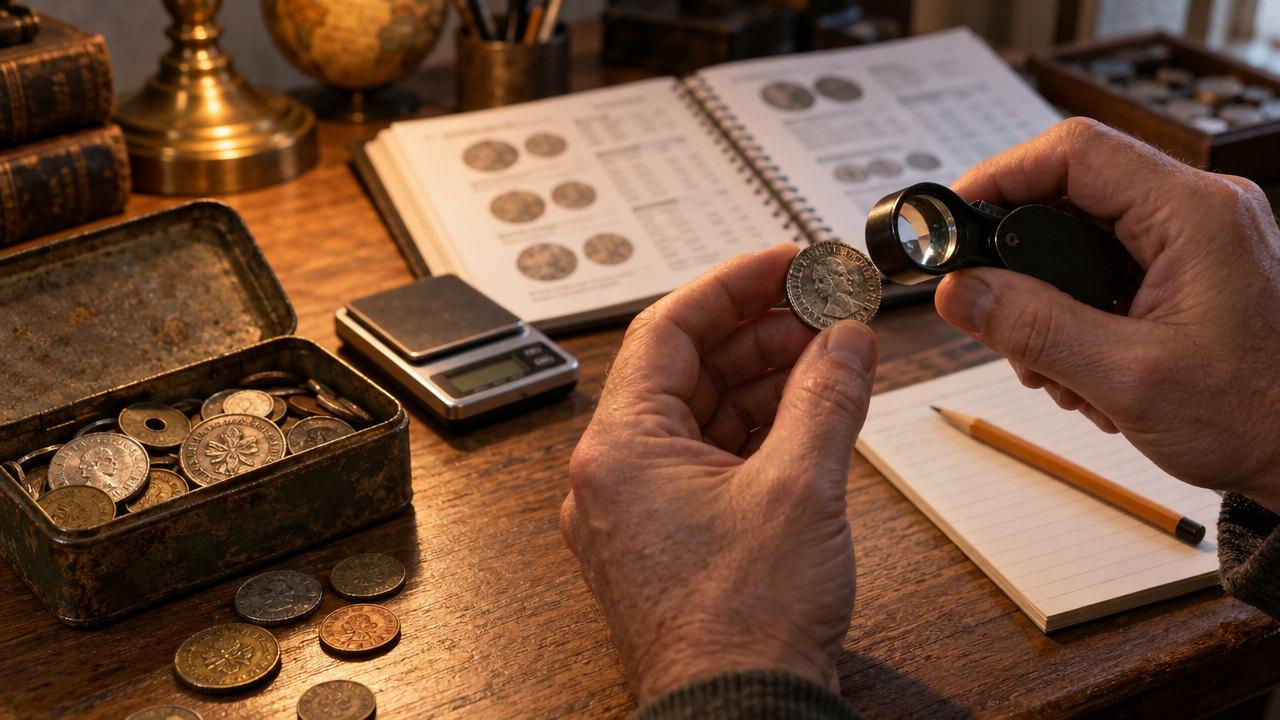
A quick home check: look at the highest points of the design (hair, cheekbones, feathers). If the fine detail is still there, the coin has seen little wear.
Metal content
Some coins are worth more for their metal than their face value. US dimes, quarters and half dollars dated 1964 and earlier are 90% silver, and so are many older world coins. These have a "melt value" floor that moves with the silver price. Weigh the coin on a small digital scale and compare it with the catalogue weight.
Demand
A coin can be rare and still not worth much if few people collect it. Popular series (US coins, British sovereigns, ancient Rome) attract more buyers than obscure ones, which pushes prices up.
Step 3: Check real prices, not asking prices
Where to look:
Sold listings on eBay.
Filter by "sold items" to see what people actually paid. Asking prices on unsold listings can be wildly optimistic.
PCGS and NGC price guides.
Both grading companies publish free price guides, mainly for graded coins.
Numista.
Shows estimated values by grade for many world coins.
Auction archives.
Major auction houses publish past results you can search.
Match the condition carefully. A price for an uncirculated example tells you nothing about a worn one.
Step 4: Don't clean it
This is the most common way people destroy value. Cleaning, polishing or dipping a coin strips its surface and leaves tiny scratches that experienced collectors spot immediately. A cleaned coin can lose half or more of its value. If a coin is dirty, leave it as it is and hold it by the edges.
Step 5: Decide whether grading is worth it
Professional grading from PCGS or NGC seals a coin in a tamper-evident holder with an official grade. It can add real value to a coin that's genuinely scarce and in good condition, and it makes a coin easier to sell.
It also costs money. Between grading fees, membership, handling and shipping, sending in a single coin usually costs more than $20 and often a lot more. As a rough rule, it's rarely worth it for a coin likely to be worth less than about $100. Check current fees on the PCGS and NGC websites first.
What about foreign coins from a trip?
Most leftover travel coins are modern circulating coins, so they're usually worth face value at best. And face value can be hard to get: banks and currency exchanges generally only take foreign banknotes, not coins.
That doesn't make them worthless to you. Circulating world coins are how most collectors start, and they're a great way into geography and history with kids. Our guide on how to start a coin collection has ideas for turning a jar of travel change into a proper collection.
Signs you might have something valuable
It's silver or gold (check the weight and look for a tarnish rather than green corrosion).
It's old and in unusually good condition.
The catalogue lists a low mintage for that year.
It has an obvious minting error, such as a doubled design or an off-center strike.
If you tick any of these, get a second opinion from a reputable local coin dealer or a coin club before you sell.
FAQ
How do I find out how much my coin is worth?
Identify it exactly (country, denomination, year, mint mark), judge its condition, then check sold prices for that coin in that condition on eBay, Numista or the PCGS and NGC price guides.
Are old foreign coins worth anything?
Most are worth face value or a few dollars to a collector. Older silver coins, low-mintage years and coins in excellent condition can be worth much more.
Should I clean old coins before selling them?
No. Cleaning almost always lowers a coin's value, sometimes by half or more. Leave it as it is.
Is it worth getting a coin graded?
Only if it's likely to be worth more than about $100. Grading fees, membership and shipping often add up to more than the value of a common coin.
Can I exchange foreign coins at a bank?
Usually not. Most banks and exchange services only accept foreign banknotes. Coins are better kept, gifted or used on your next trip.
What does a grade like MS-65 or VF-20 mean?
It describes condition on the 1 to 70 Sheldon scale. MS means Mint State (no wear) and VF means Very Fine (moderate wear). See our full coin grading guide.
Keep the story, even if it isn't rare
Most coins in a family tin won't pay for a vacation. But each one came from somewhere, and finding out where is half the fun. If you'd like to keep going, Coin & Currency Club sends real coins and banknotes from a new country every month, with the history behind them. The first month is $15.