
Coin Grading Explained: What Do MS-65, AU-58, and Other Grades Mean?
A plain-English guide to the coin grading scale, from Poor to Mint State 70, plus what PCGS and NGC grades actually mean for a coin's condition and value.
Two coins can look almost identical to an untrained eye and be worth wildly different amounts. The difference usually comes down to grading: a standardized way of describing exactly how much wear, damage, or original mint quality a coin has. Once you know how to read a grade like "MS-65" or "AU-58," a lot of coin listings and price guides suddenly make a lot more sense.
This guide walks through where the grading scale comes from, what the letters and numbers actually mean, and how much it should matter for a collector who isn't buying or selling high-value coins.
The Sheldon Scale: Coin Grading From 1 to 70
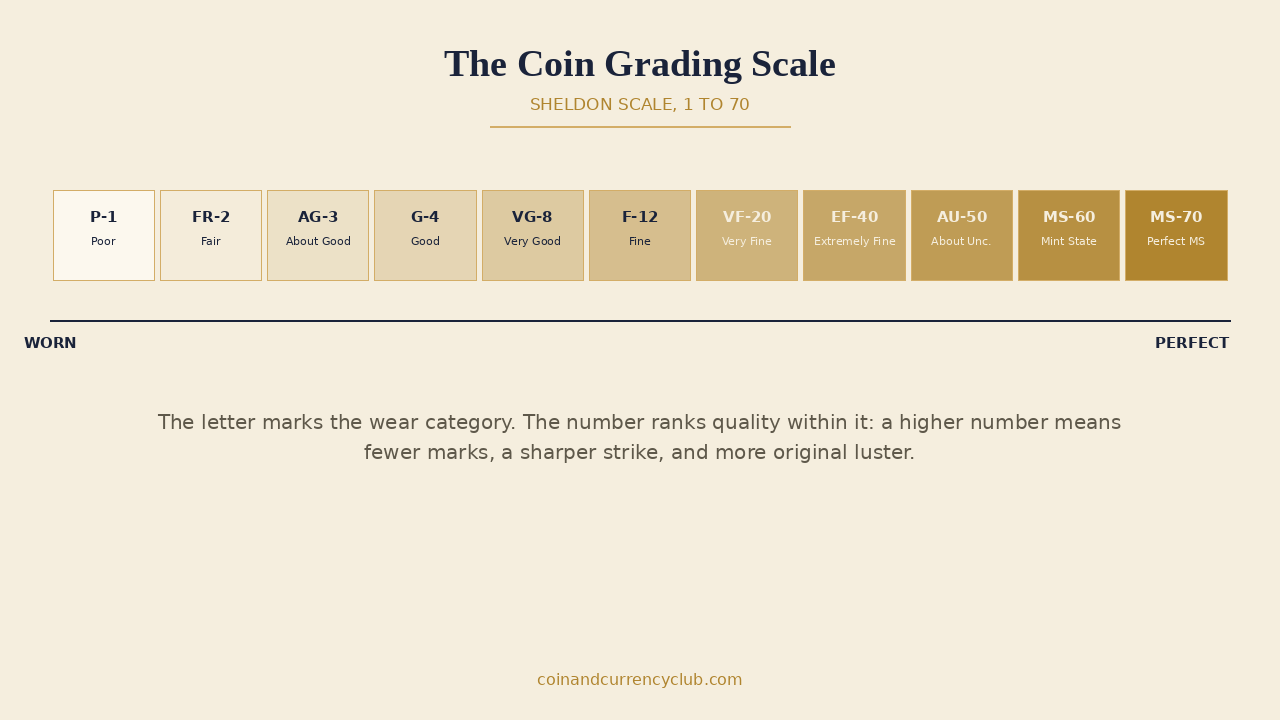
Coin grading in the US is built on the Sheldon Scale, created by numismatist William Sheldon in 1949 for grading large cents. It's since become the industry standard for grading coins of all kinds, running from 1 (barely identifiable) to 70 (a theoretically perfect coin).
Grade | Name | What It Means |
|---|---|---|
P-1 | Poor | Barely identifiable, heavily worn or damaged |
FR-2 | Fair | Major design elements visible but very worn |
AG-3 | About Good | Outline visible, most detail worn away |
G-4 to G-6 | Good | Design fully visible but flat and worn |
VG-8 to VG-10 | Very Good | Moderate wear, major details start to show |
F-12 to F-15 | Fine | Moderate to light wear, most details clear |
VF-20 to VF-35 | Very Fine | Light wear on the highest points only |
EF-40 to EF-45 | Extremely Fine (also XF) | Very light wear, sharp detail |
AU-50 to AU-58 | About Uncirculated | Trace of wear, most of the original mint luster present |
MS-60 to MS-70 | Mint State (Uncirculated) | Never circulated; graded on marks, luster, and strike quality |
Specially struck coins made for collectors rather than circulation use a parallel PF (Proof) or PR scale, also running up to 70.
What the Letters Actually Mean
Once you know the abbreviations, most coin listings stop looking like code.
MS (Mint State): The coin was never in circulation. Grading within this range is about the quality of the strike, the surface marks it picked up in handling and storage, and how much of the original mint luster remains.
AU (About Uncirculated): Extremely light wear, usually from brief handling, with most of the original luster intact.
XF / EF (Extremely Fine): Light, even wear on only the highest points of the design.
VF (Very Fine): Moderate wear, but all major details remain clear.
F, VG, G, AG, FR, P: Progressively more worn, with detail becoming harder to make out as the grade drops.
PF / PR (Proof): Not a wear grade at all, but a manufacturing category. Proof coins are struck specially, often with mirror-like fields, for collectors rather than circulation.
You'll also see modifiers attached to these, like a "+" for a coin that's stronger than typical for its grade, "Details" for a coin with an issue (cleaning, damage) that keeps it out of the standard numeric scale regardless of wear, or "Cameo"/"Deep Cameo" on proof coins with strong contrast between the design and the field.
Why the Number After the Letter Matters
It's tempting to treat "Mint State" as one bucket, but MS-60 and MS-70 can be worth very different amounts for the same coin. Within Mint State, the grade comes down to how few marks the coin picked up during minting and handling, how sharp the strike is, and how much original luster survives. A coin graded MS-65 is meaningfully nicer, and often meaningfully more valuable, than the same coin graded MS-61, even though both are technically "uncirculated."
The same logic applies further down the scale. A VF-20 and a VF-35 coin are both "Very Fine," but the higher number means less wear within that category. For anything beyond casual collecting, the specific number matters as much as the letter grade.
Who Actually Grades Coins
Self-assessed ("raw") coins are graded informally by whoever's looking at them, which is fine for casual collecting but doesn't carry much weight for buying, selling, or insurance purposes. For that, collectors rely on third-party grading services, most commonly PCGS (Professional Coin Grading Service) and NGC (Numismatic Guaranty Company).
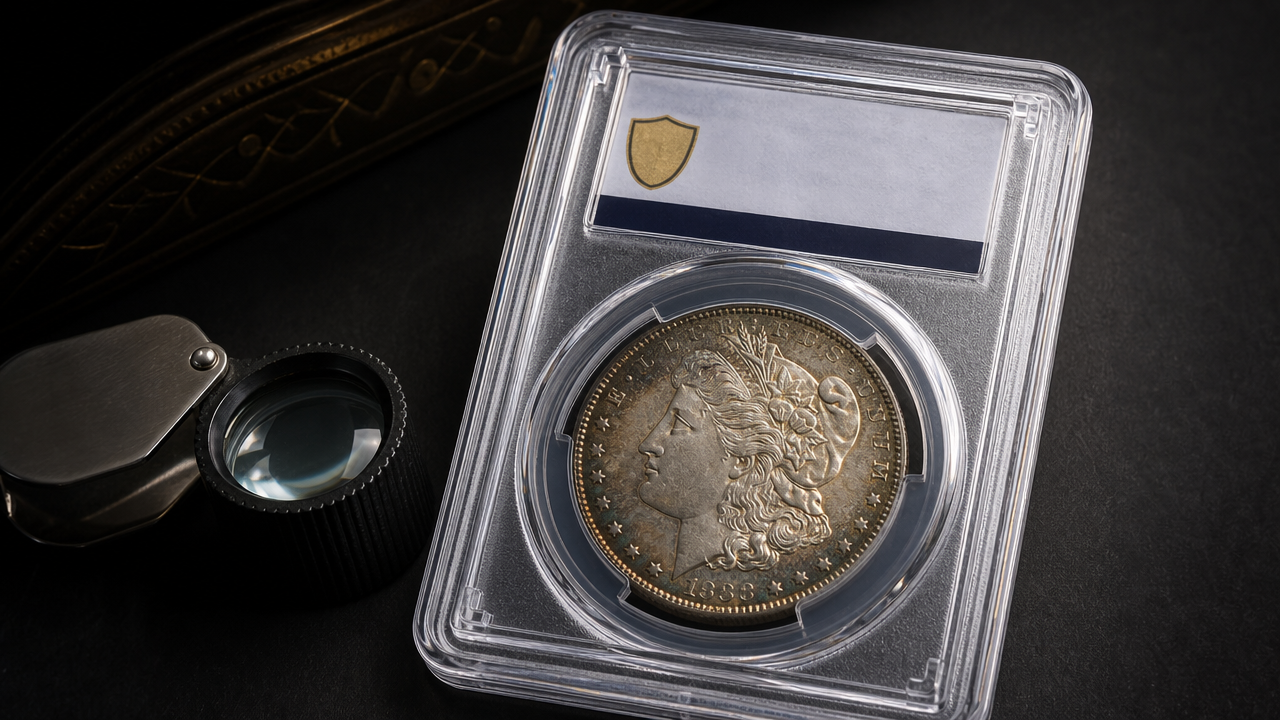
Both services examine a submitted coin, assign an official grade, and seal it in a tamper-evident plastic holder, commonly called a "slab," with the grade and a certification number permanently displayed. A slabbed coin is authenticated and graded by a neutral third party, which is a meaningful trust signal for resale and insurance. A PCGS or NGC grading submission is also a genuinely useful gift for a collector who has coins they've been meaning to get authenticated.
Does Grading Matter for a Beginner Collector?
Not much, at least not at first. For most casual and world coin collectors, an ungraded ("raw") coin in reasonable condition is a perfectly good addition to a collection, and paying for third-party grading on a low-value coin usually costs more than the coin is worth. Grading becomes genuinely relevant once a collection includes coins with real resale value, or when a collector wants formal documentation for insurance purposes.
If you're just starting out, it's worth knowing how to read a grade when you see one, so you understand what a listing or price guide is telling you, without needing to get everything in your own collection professionally graded.
A Quick Glossary of Related Terms
Term | Meaning |
|---|---|
Patina | The natural surface toning a coin develops over time; removing it (cleaning) typically lowers value |
Luster | The way light reflects off an uncirculated coin's surface; a key factor in Mint State grading |
Strike | How completely and sharply the coin's design was stamped during minting |
Slab | The sealed plastic holder a third-party graded coin is stored in |
Raw coin | A coin that hasn't been professionally graded and slabbed |
Error coin | A coin with an unintentional minting mistake (off-center strike, doubling, wrong planchet), sometimes more valuable because of it |
Key date | A specific year or mint mark within a series that's notably rarer and more valuable than the rest |
FAQ
What does MS-65 mean on a coin?
MS stands for Mint State, meaning the coin was never in circulation. The number, 65 in this case, reflects the specific quality within that category, based on surface marks, strike sharpness, and luster. Higher numbers mean fewer marks and a better strike.
What's the difference between PCGS and NGC?
Both are independent third-party coin grading services that authenticate and grade coins, then seal them in tamper-evident holders. They use the same underlying Sheldon Scale and are both widely trusted; some collectors have a preference between the two, but neither is objectively more accurate than the other for most coins.
Is it worth getting my coins graded?
For low-value or casual collection coins, usually not, since grading fees can exceed the coin's value. For coins you believe are genuinely valuable, or that you want documented for insurance or resale, third-party grading is generally worth it.
What is a "raw" coin?
A raw coin is one that hasn't been professionally graded and sealed by a service like PCGS or NGC. Most coins in casual collections, including most world coin collections, are raw, and that's entirely normal.
Can I grade my own coins accurately?
You can estimate a grade using reference guides and photos of graded examples, and it's a useful skill to build. But self-graded estimates aren't a substitute for third-party grading if a coin's actual resale or insurance value depends on getting it right.
Conclusion
Coin grading looks like a code at first, but it's really just a shared vocabulary for describing wear and quality consistently. Once you can read a grade like AU-58 or MS-65 and know roughly what it's telling you, price guides and listings stop being confusing, and you'll have a much better sense of what you're actually looking at, whether that's a coin you already own or one you're thinking about adding to your collection.