Seven hands-on money lessons using real world currency, from sorting coins with young kids to exchange rates, budgets and hyperinflation for older ones.
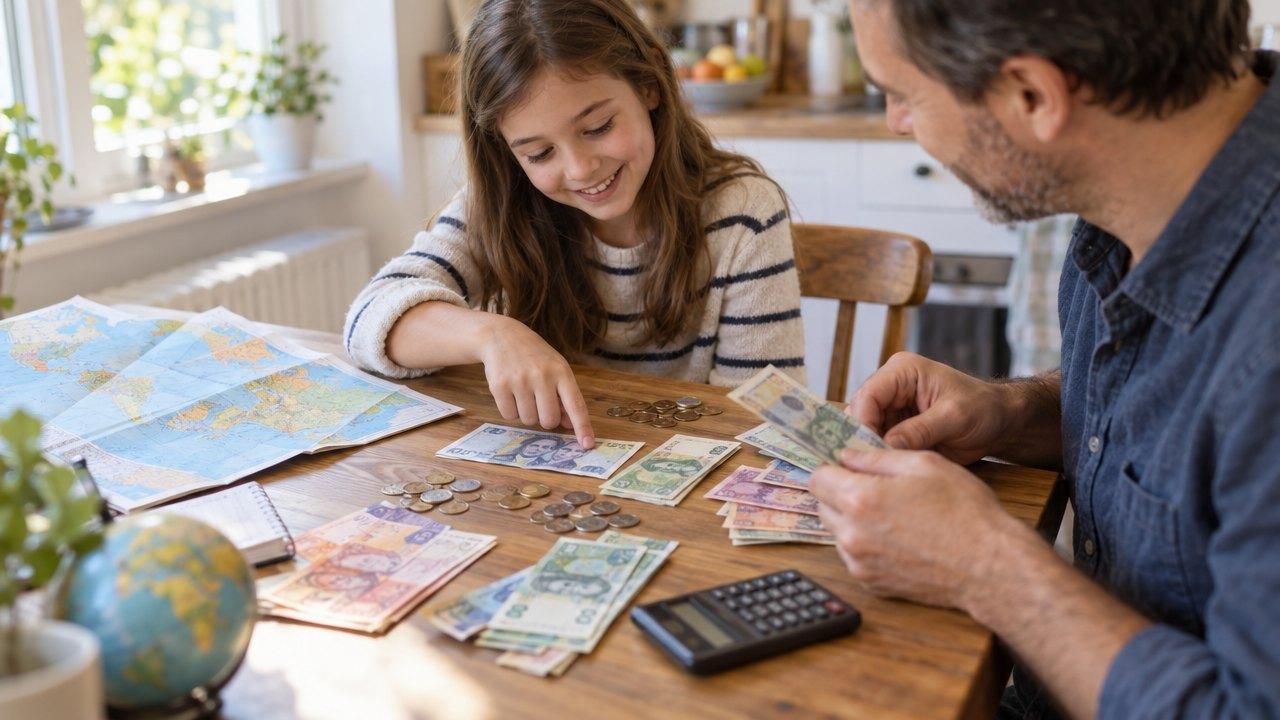
Most money lessons for kids start with counting change, and most kids switch off by the second quarter. Real banknotes from other countries change that. They're colorful, they're strange, they have animals and volcanoes and astronauts on them, and every one raises a question: what can you buy with this?
That curiosity is a great way into the money skills kids actually need: what money is, what things cost, how to plan a budget and why prices change. Here are seven lessons you can do at the kitchen table, roughly in order of age.
Why world currency works so well
It's tangible.
Kids can hold it, sort it and compare it. Abstract ideas like value and exchange become physical.
It removes the habits.
A child who "knows" a dollar has to think again with a 1,000 yen note. That's when real learning happens.
It connects to everything else.
Every note is also a geography, history and art lesson, which is why homeschool families use it across subjects (see our
homeschool coin collecting guide
).
Lesson 1: What is money, anyway? (ages 5 and up)
Start with a trade. Give two kids different snacks and let them swap. Then ask: what if I want your apple but you don't want my crackers? That's the problem money solves. It's something everyone agrees to accept.
Then put a foreign banknote on the table and ask whether you could buy candy with it at your local store. No? So why is it money? Because people in its own country agree it is. It's a good first step toward understanding that money's value comes from trust.
Lesson 2: Sort and compare (ages 5 to 8)
Hand over a mixed pile of coins and notes and let kids sort them however they like: by color, by size, by country, by picture. Then ask questions:
Which country is this from? Can you find it on the map?
Which is the biggest number? Does the biggest number mean it's worth the most?
Whose face is on it, and why do you think they chose that person?
Young kids often assume a 1,000 note is worth more than a 1 note from another country. That opens up the next lesson.
Lesson 3: Exchange rates as a shopping game (ages 8 and up)
Look up today's exchange rate for two or three currencies you have (any currency converter will do). Then set up a "shop" with price tags in dollars and ask kids to pay in foreign money.
For example, if a toy costs $10 and the yen is around 150 to the dollar, they'll need about 1,500 yen. Older kids can handle percentages: what happens to the price if the rate moves 10%?
This lesson sneaks in a lot of math: multiplication, division, rounding and estimating. It also explains something adults find confusing, which is why a vacation costs more some years than others.
Lesson 4: Plan a pretend trip budget (ages 9 and up)
Pick a country from your collection. Give your child a budget in dollars for a three-day pretend trip. They have to research what a meal, a train ticket and a museum entry cost there, convert the prices and make the money last.
Kids learn more from overspending on day one and running short on day three than from any worksheet. Let them make the mistake on paper.
Lesson 5: Inflation, with real notes (ages 10 and up)
Inflation is hard to explain and easy to show. Venezuela is the clearest example of recent years:
In 2018 Venezuela introduced the bolívar soberano, knocking five zeros off the old currency.
Prices kept rising so fast that by 2021 the central bank was printing notes worth 500,000 and 1,000,000.
Later in 2021, it knocked six more zeros off with another new currency.
Lay out a 5 bolívar note next to a 1,000,000 note from just a few years later. Ask your child what they think happened to the price of bread. (Our Venezuela hyperinflation banknote set has five real notes for exactly this lesson.)
Zimbabwe's 100 trillion dollar note from 2009 is another famous example. Then bring it home: what did a candy bar cost when you were a kid?
Lesson 6: Money changes (ages 8 and up)
Currencies aren't permanent. Show kids a coin from a currency that no longer exists, such as French francs, German marks or Italian lire, which were all replaced by the euro. The euro area keeps growing. Bulgaria switched from the lev to the euro on January 1, 2026, making it the 21st country to use it.
Good questions to ask: Why would countries share one currency? What might they give up? It's a gentle introduction to economics and to how countries cooperate.
Lesson 7: Spot the security features (ages 7 and up)
Modern banknotes are full of anti-counterfeiting features, and finding them is a treasure hunt. Hold notes up to a window and look for:
Watermarks
, faint images visible only against light.
Security threads
woven through the paper.
Holograms and color-shifting ink
that change as you tilt the note.
Clear windows
on polymer (plastic) notes. Australia issued the world's first polymer banknote in 1988, and Canada, the UK and many others use them now.
Then talk about why governments go to so much trouble. Kids get the point fast: money only works if people trust it.
Tips for making it stick
Keep it short.
Fifteen to twenty minutes is plenty for younger kids.
Let them keep something.
A coin of their own makes the lesson memorable.
Connect it to real spending.
Next time you're at the store, ask how much the shopping would cost in yen or euros.
Write it down.
A notebook with one page per country (map, currency, prices) becomes a record of what they've learned.
Where to get real world currency
Leftover travel money
from family and friends. Ask around; most people have some in a drawer.
Coin dealers and shows
, where common world coins often sell for under a dollar.
A subscription.
sends real coins and banknotes from a different country every month, with a guide to the country's history, culture and economy and a short video lesson. It's built for ages 5 to 15, and the first month is $15.
FAQ
How do you teach kids about money in a fun way?
Use real objects and games. Sorting foreign coins, running a pretend shop with exchange rates and planning a trip budget all teach money skills without feeling like a worksheet.
At what age should kids learn about money?
Kids can start around age 5 with the basics: what money is and how to sort and count it. Exchange rates and budgeting suit ages 8 and up, and inflation works well from about 10.
Is there a subscription that teaches kids about money?
Coin & Currency Club sends real currency from a new country each month with history, culture and economics built in. It pairs well with the lessons above, especially exchange rates and inflation.
How do you explain inflation to a child?
Show it. Put an old low-value banknote next to a much bigger note from the same country a few years later, such as Venezuela's 2018 and 2021 notes, and ask what happened to prices.
Can foreign currency be used for homeschool economics?
Yes. It covers economics, math, geography and history at once, and it's easy to scale from kindergarten to high school.
The bottom line
Kids don't need a finance course to understand money. They need something they can hold and a few good questions. A pile of real banknotes from around the world gives you both.