
Coin Collecting for Homeschoolers: A Geography and History Curriculum Guide
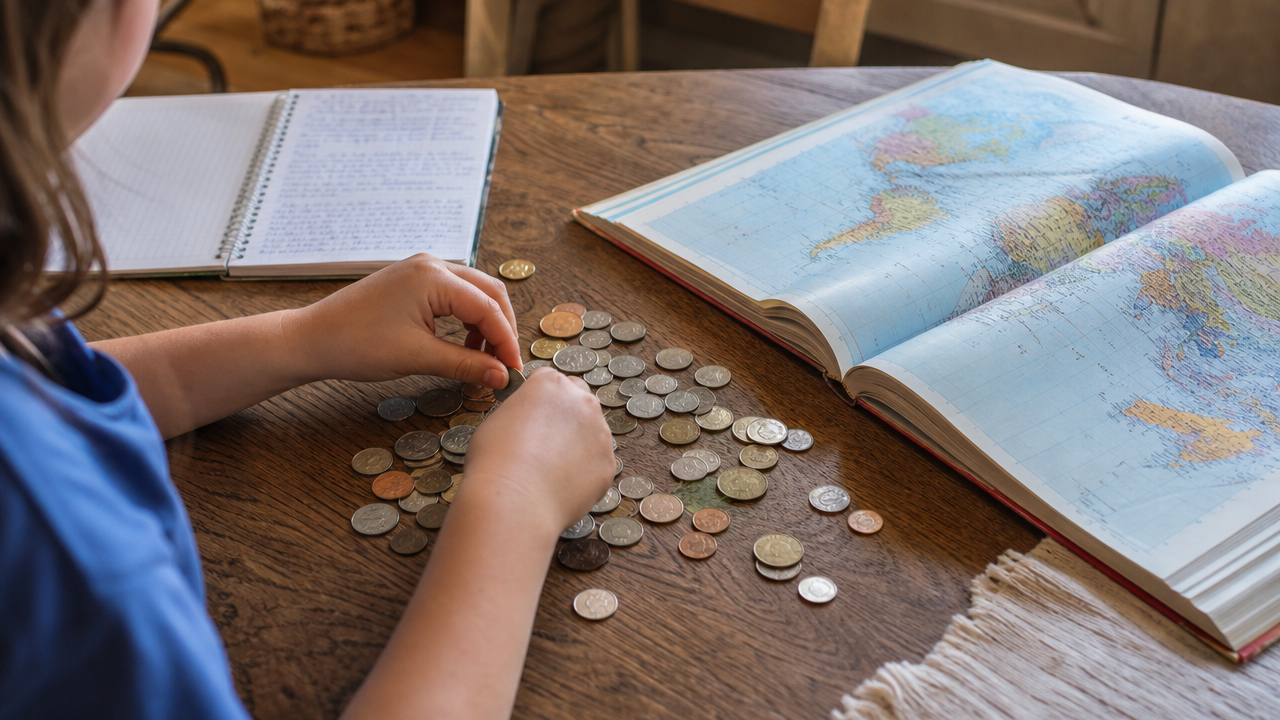
Turn coin collecting into a real homeschool subject. Age-by-age lesson ideas, how coins map to geography and world history, and where to get coins to start.
Most homeschool parents have the same problem at some point: geography and world history are easy to explain in theory and hard to make stick. A worksheet about Peru is forgettable. A real Peruvian coin in a kid's hand, with a question attached to it like "why is a condor on this?", tends not to be.
Coin collecting isn't usually pitched as a curriculum tool, but it quietly covers geography, history, economics, and even a bit of art, all from one object a kid can hold and ask questions about. This guide covers how to actually build it into what you're already teaching, by age, without turning it into another subject to plan from scratch.
Why Coins Work as a Teaching Tool
A coin is a small, durable, genuinely foreign object. That combination does a lot of work on its own.
It's tangible in a way a textbook page isn't. Kids can hold it, examine it under a loupe, and notice details a photo would flatten out. That kind of physical engagement tends to make information stick longer than reading about the same country would.
It's naturally cross-subject. A single coin can anchor a geography lesson (where is this country, what's it near), a history lesson (who's depicted, what era, what happened to that currency since), an economics lesson (what's this worth, how does exchange rate work), and even an art lesson (national symbols, engraving style, how coin design has changed over time).
It scales with age without much adjustment. A six-year-old can sort coins by country and match them to a map. A twelve-year-old can research the history behind what's pictured and write a short report. Same object, different depth.
It's inexpensive to start. A handful of coins from a trip, a coin jar, or a modest subscription is enough to build a real collection over a school year. You don't need a curriculum purchase to begin.
Mapping Coin Collecting to What You're Already Teaching
Geography
Every coin has a country of origin, which is the easiest possible entry point into a geography lesson. Locate it on a map or globe, find its capital, note which continent and which neighboring countries it borders. Over a school year, a coin collection can become a physical record of every country a family has "visited" through the hobby.
World History
Coins are historical documents that happen to be currency. Who's on the coin, and why? What era does it come from? Has the country's currency changed since, and what does that change tell you (a new government, a currency reform, independence from a colonial power)? A single coin from, say, a country that's changed its name or currency in the last fifty years can anchor an entire history discussion.
Economics and Math
Denominations, currency conversion, and basic economics fit naturally here. Younger kids can practice comparing coin values; older kids can research current exchange rates and calculate what a coin's face value would be in US dollars today, or discuss why some currencies are worth more than others.
Art and Design
National symbols, portraiture, and engraving style are worth a closer look with a loupe. Many countries put deliberate national symbolism on their coins: animals, monuments, cultural icons. It's a small but genuine art history lesson hiding inside a coin collection.
An Age-by-Age Approach
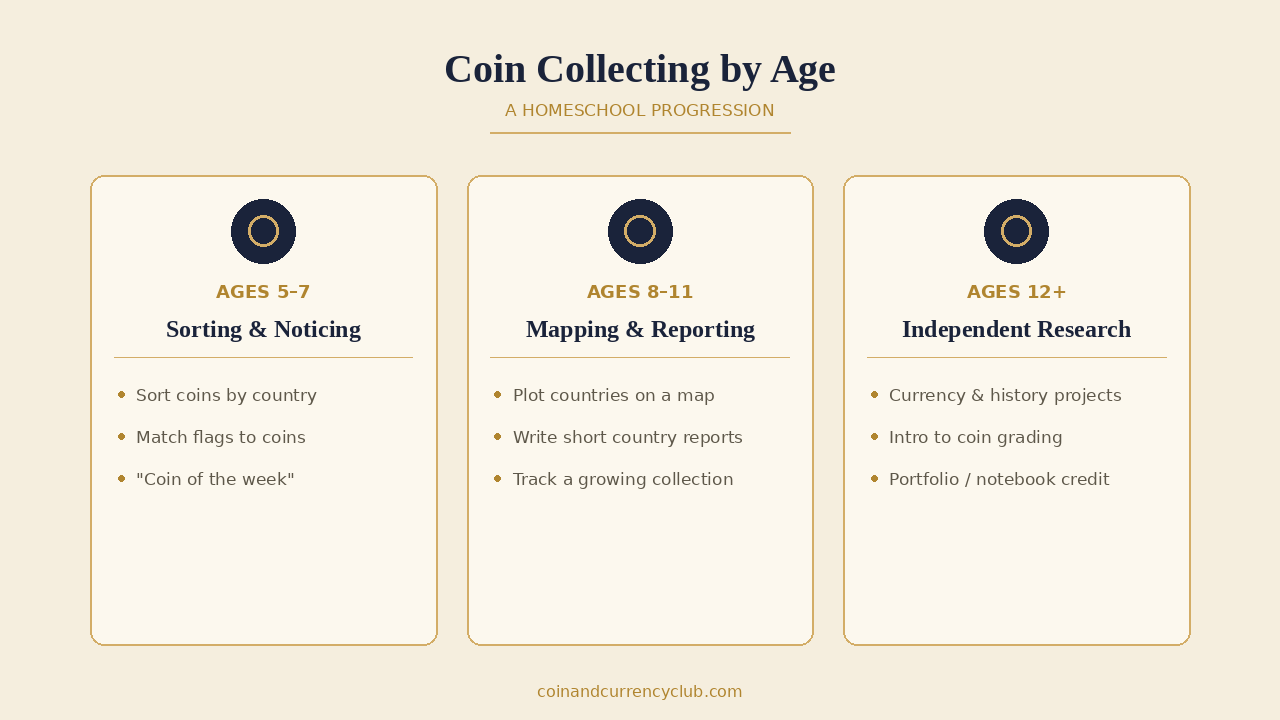
Ages 5–7: Sorting and Noticing
At this age, the goal is simple exposure and pattern recognition, not research. Sort coins by country or by color and metal. Match a coin to its country's flag. Do a weekly "coin of the week" where the child shows a favorite coin and says one thing they notice about it.
Ages 8–11: Mapping and Reporting
Kids at this age can start connecting coins to a physical map, plotting pins or stickers for every country represented in the collection. A simple one-paragraph "country report" (capital, one historical fact, what's on the coin and why) works well as a short writing exercise tied to something they're actually curious about.
Ages 12 and Up: Independent Research
Older kids can take on a country or region as an independent project: currency history, major historical events tied to what's depicted, and how the economy has changed. This is also a natural point to introduce basic numismatics concepts like coin grading and condition, which adds a research and evaluation skill on top of the history and geography.
Building It Into Your Curriculum
Anchor it to a rhythm. A "country of the month" structure works well and mirrors how curated coin subscriptions are often organized, giving you a natural pace without having to plan a new topic every week.
Pair it with what you're already using. History curricula organized chronologically or by region (world history surveys, geography co-ops) both pair naturally with a coin collection: whatever region or era you're covering, pull the matching coin out and use it as a physical anchor for that unit.
Keep a notebook. A simple notebooking page per country, coin details, map location, one historical note, works well for portfolio or record-keeping purposes and gives kids something tangible to look back on across a school year.
Use it in a co-op setting. Coin collecting works well as a group activity: kids can trade duplicates, present a country to the group, or compare notes on what they've found. It's a good fit for a monthly homeschool co-op session.
Where to Get Coins for a Homeschool Collection
A curated subscription is the simplest way to start without doing the sourcing work yourself. Coin & Currency Club sends authentic coins and banknotes from a different country each month, along with a cultural guide and map, which does a lot of the lesson-planning for you.
Pocket change and travel. If your family travels, holds onto foreign currency, or has relatives abroad, that's a free starting point.
Local coin shows and clubs. Many areas have a local coin club or regular coin show, both good low-cost sourcing options and a chance for kids to talk to experienced collectors directly.
Be cautious with random online lots. Large mixed lots of "world coins" sold cheaply online are sometimes low-value or misrepresented. For a homeschool collection, a smaller number of verified, genuine coins is worth more than a large pile of uncertain ones.
FAQ
Is coin collecting actually educational for homeschoolers?
Yes. It naturally covers geography, world history, basic economics, and art, and it scales in depth from simple sorting for young kids to independent research projects for teens. Many homeschool families already use it informally without calling it a curriculum.
What age can kids start a coin collecting curriculum?
Kids as young as five or six can start with simple sorting and matching activities. The hobby scales with age rather than requiring a specific starting point, so there's no wrong age to begin.
Can coin collecting count as a homeschool subject or go toward a portfolio?
In many homeschool approaches, yes, especially when documented with a notebook or portfolio page per country or coin. Requirements vary by state and by homeschool method, so it's worth checking your own state's homeschool regulations if you're planning to count it formally toward a subject or credit.
How much does a homeschool coin collecting curriculum cost?
It can start at effectively no cost using existing pocket change or travel currency. A modest monthly subscription is typically in the $20–$30 range if you'd rather not source coins yourself.
Do I need to know a lot about coins to teach this?
No. The coins themselves, plus a map and basic internet research, are usually enough. Curated subscriptions that include a cultural guide with each coin remove most of the need for the parent to already be a numismatics expert.
Conclusion
Coin collecting isn't a replacement for a geography or history curriculum, but it's an unusually effective supplement: cheap to start, naturally cross-subject, and genuinely interesting to kids in a way a lot of curriculum material struggles to be. Whether you build it into a formal rhythm or let it run alongside what you're already teaching, it tends to earn its place quickly.
If you'd rather not source coins yourself, Coin & Currency Club does the curating for you, one country and one cultural guide at a time.