
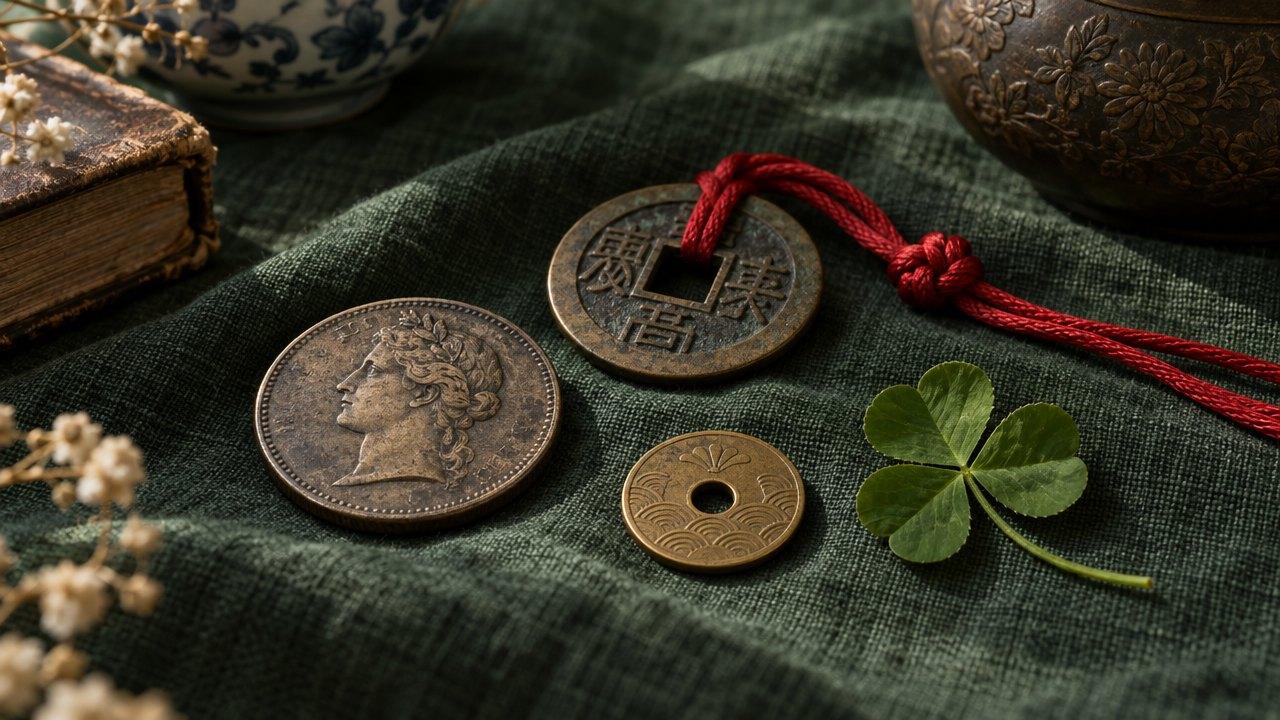
Why an old Irish penny, a Chinese coin with a square hole and a Japanese 5 yen coin are all thought to bring good luck, and where the traditions come from.
People have been treating coins as good-luck charms for almost as long as there have been coins. A coin is small, it lasts and it stands for prosperity, so it's an easy thing to pin a wish on. What's interesting is how differently each culture does it. In one country the luck comes from the picture on the coin, in another from a pun on its name, and in a third from where you find it.
Here are seven of the best-known lucky coin traditions, and the real history behind them.
1. The Irish penny
Ask an American where lucky coins come from and many will say Ireland. The coin people usually mean is Ireland's pre-decimal penny, minted from 1928 to 1968.
It's a lovely piece of design. The front has an Irish harp. The back shows a hen with five chicks, one of a set of farm-animal designs that the English sculptor Percy Metcalfe created for the new Irish Free State's coins. The penny is bronze and about 31 mm across, roughly the size of a US half dollar, so it feels substantial in the hand. It stopped being legal tender at the end of 1971, after Ireland switched to decimal currency.
Why lucky? Partly the general "luck of the Irish" idea, and the four-leaf clovers and leprechauns that go with it. PCGS notes that the phrase may trace back to Irish-born miners in 19th-century America. Ireland also had a real coin custom of its own, the "luck penny": after a sale at a fair or market, the seller would hand a small coin back to the buyer for luck.
Most Irish pennies are common and affordable, which is exactly why they work as gifts. Our Lucky Irish Penny is one of these 1928 to 1968 pennies.
2. Chinese cash coins
For around two thousand years, Chinese coins were round with a square hole in the middle. The hole was practical: coins were strung together on cords in groups for counting and carrying. The shape is also often read as symbolic, with the round outside standing for heaven and the square hole for earth.
These "cash coins" became good-luck charms long after they stopped being money. You'll see them tied with red string (red being the color of luck and celebration in Chinese culture) and hung in homes, cars and shops, often in sets of three or five. They're a common feature in feng shui.
There's also an old fortune-telling tradition. One way of consulting the I Ching, the ancient Chinese book of divination, is to throw three coins six times and read the pattern of heads and tails. Our Lucky Chinese Coin nods to that tradition.
3. Japan's 5 yen coin
Japan's 5 yen coin is gold-colored brass with a hole in the middle, and it's considered lucky because of a pun. "Five yen" is go en. Go-en (ご縁) is also a word for a connection or bond, the kind of fate that brings people together.
That's why you'll see people toss 5 yen coins into the offering box at shrines, tuck them into new wallets or give them to friends. There's no rule that says the offering has to be 5 yen, and any amount is fine, but the pun is well known enough that many people reach for one.
4. The silver sixpence
In Britain, a sixpence has been a lucky coin for weddings and Christmas.
The wedding version comes from the old rhyme: "Something old, something new, something borrowed, something blue, and a silver sixpence in her shoe." The bride wears the coin in her left shoe for wealth and happiness in the marriage. Many people know the first four lines without realizing the rhyme had a fifth.
The Christmas version is the coin hidden in the Christmas pudding. Whoever finds it in their portion gets luck for the coming year (and a reminder to chew carefully).
The sixpence hasn't been legal tender since 1980, so today's brides usually use an old one or a commemorative coin made for the purpose.
5. The American lucky penny
"Find a penny, pick it up, all day long you'll have good luck." This one is about where you find the coin, not the coin itself. Many people add a condition: it only counts if the penny is heads up.
It's a nice tradition with a complicated future. The US Mint stopped striking pennies for circulation in 2025, so there will gradually be fewer of them on the ground to find.
6. The coin in the New Year cake
In Greece and Cyprus, families bake a vasilopita for New Year's Day with a coin hidden inside. The cake is cut in a set order, with slices for family members, the household and sometimes for St. Basil, and whoever finds the coin is said to have good luck for the whole year. Similar traditions exist across the Balkans and elsewhere, sometimes baked into bread instead of cake.
7. The Trevi Fountain toss
In Rome, tradition says that if you throw a coin over your shoulder into the Trevi Fountain, you'll return to the city one day. Most guides say to use your right hand over your left shoulder.
It's one of the few lucky coin customs that does measurable good. The city collects the coins regularly, and the money goes to charity. Thousands of euros a day land in the fountain.
Why coins, and not something else?
Every one of these traditions picks a coin for similar reasons:
Coins last.
A charm that survives decades in a pocket feels like it should carry luck forward.
Coins mean prosperity.
Holding on to one is a small wish for more.
Coins are shared.
Everybody uses them, so the tradition is open to everyone, rich or poor.
They're also a great way into history for kids. A lucky coin comes with a story, the story comes with a country and the country comes with a map.
FAQ
What coin is considered lucky?
It depends on the country. The Irish penny with the hen and chicks is popular in the US, Chinese coins with a square hole are lucky in China, the 5 yen coin is lucky in Japan, and the silver sixpence is lucky at British weddings.
Why is the Irish penny lucky?
Mostly because of Ireland's association with luck: four-leaf clovers, leprechauns and the phrase "the luck of the Irish." Ireland also had a "luck penny" custom, where a seller gave a small coin back to the buyer after a sale.
What do you do with a Chinese lucky coin?
Many people tie it with red string and hang it at home, in a car or near the front door of a business. Coins are often grouped in threes or fives.
Why is the 5 yen coin lucky?
"Five yen" is pronounced go en, which sounds like the Japanese word for a bond or connection. People give or offer 5 yen coins to wish for good relationships.
Is a lucky coin a good gift?
Yes, especially for someone who isn't a collector yet. A lucky coin is inexpensive, it comes with a story, and it's easy to carry. See our Christmas gifts for coin collectors under $25 for more ideas.
Start your own collection of stories
Every coin has a story behind it, and lucky coins just make it easier to see. If you'd like a new country's coins, banknotes and stories in the mail each month, take a look at Coin & Currency Club. The first month is $15.