
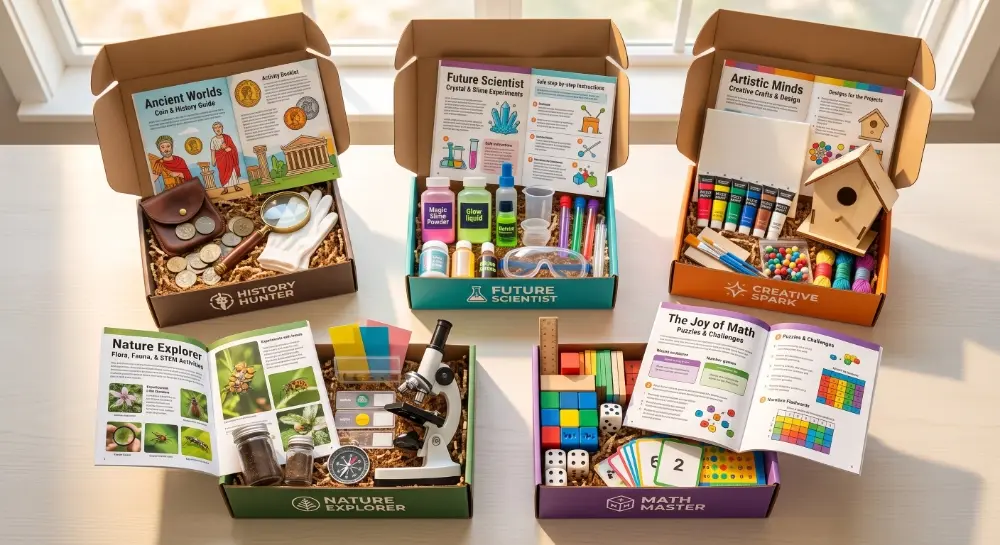
Discover the best educational subscription boxes for kids in 2026 — from STEM science kits to world culture and coin collecting. Find the perfect box for curious minds.
Every parent wants their child to keep learning when school is out. The challenge is finding something that holds a child's attention long enough to actually teach them something, and doesn't end up gathering dust after the first week.
Educational subscription boxes solve this surprisingly well. The best ones arrive like a gift, spark genuine curiosity, and leave kids knowing something real about the world. In 2026, the category has matured significantly, and there are now boxes for virtually every interest: science experiments, coding, cooking, art, geography, and world culture.
This guide covers the best educational subscription boxes for kids across different ages, interests, and budgets, with honest notes on what each one does well and who it's best for.

What Makes an Educational Subscription Box Worth It?
Before jumping into the list, it's worth knowing what separates a great educational box from a forgettable one.
The best boxes share a few qualities. The activities are genuinely hands-on, not just reading a pamphlet. The content connects to something larger, whether that's a science concept, a world culture, or a real skill. And the quality is high enough that kids want to engage with it rather than race through it.
Price is also worth thinking about clearly. Most boxes run $15–$35 per month. The question isn't whether that's cheap, but whether the experience is worth more than the equivalent in books, museum tickets, or craft supplies. For the boxes on this list, the answer is usually yes.
The Best Educational Subscription Boxes for Kids in 2026
1. Coin & Currency Club, Best for World Culture and History
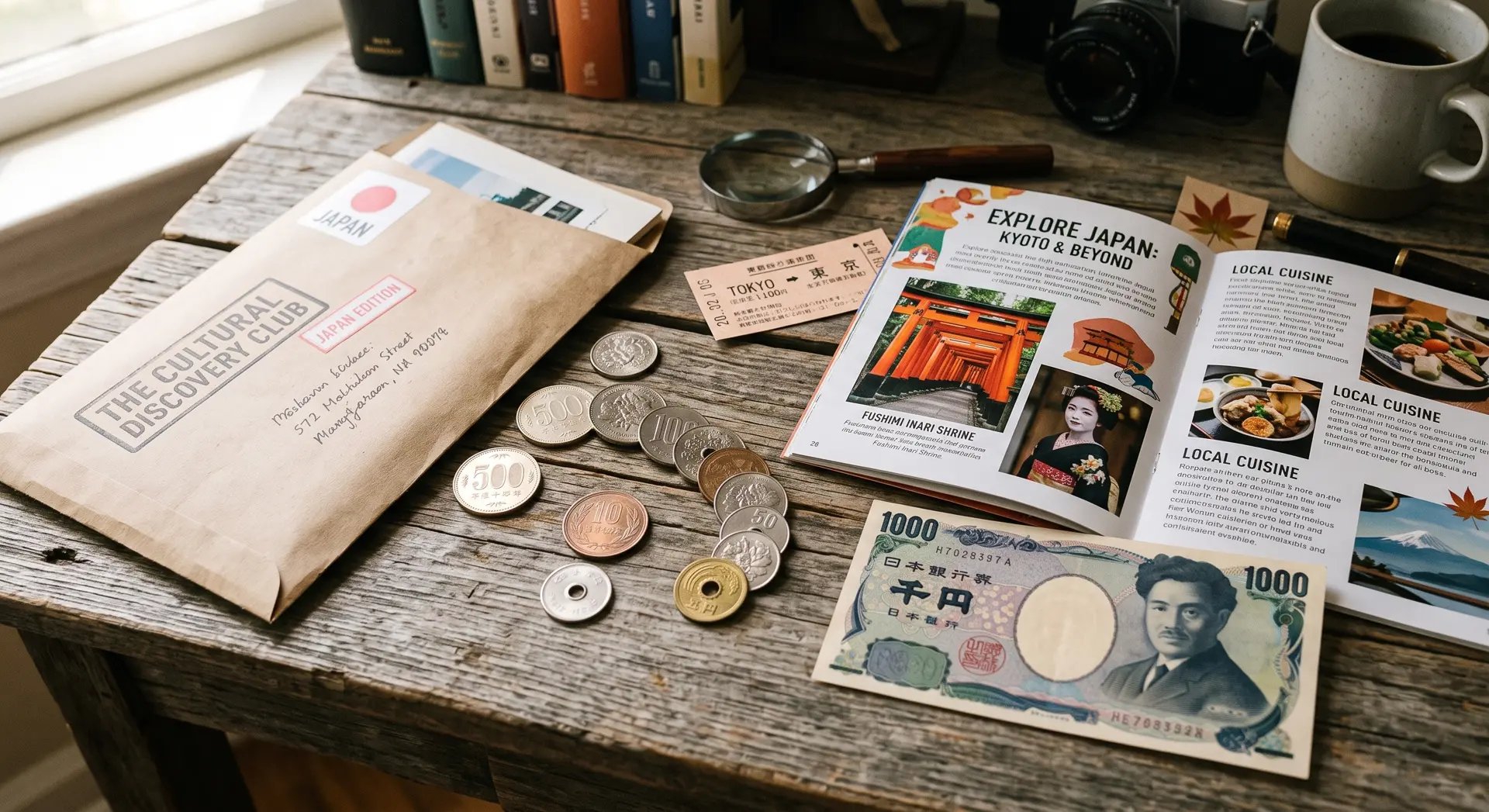
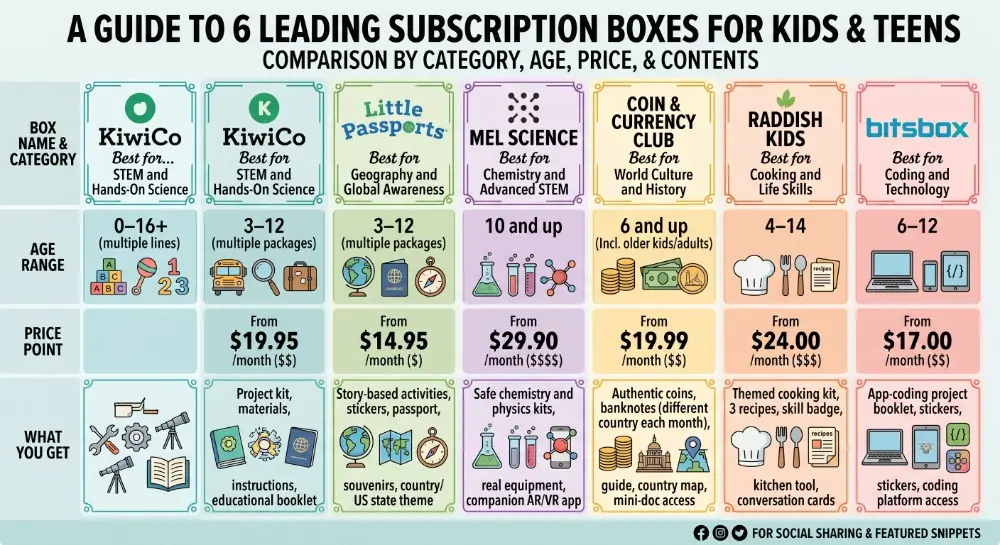
Age range: 6 and up (great for older kids and adults too) Price: From $19.99/month What you get: Authentic coins and banknotes from a different country each month, a cultural guide, a country map, and access to a mini-documentary about that month's featured nation
Coin & Currency Club does something no other subscription box does: it puts real, authentic artifacts from around the world in a child's hands. Each month focuses on a single country, coins and banknotes from that nation, along with the cultural context that makes them meaningful.
This isn't a box full of plastic toys that get thrown away. The coins are real currency, the kind that has actually changed hands in their country of origin. That alone makes it different: children are holding a piece of another country's history.
What makes it educational: geography, world history, numismatics (the study of coins and currency), and cross-cultural understanding are all woven naturally into each packet. It's one of the few subscriptions that scales with age, a six-year-old can sort coins by country while a twelve-year-old reads the cultural guide and looks up the country on a map.
Best for: Curious kids, families who travel or want to inspire a love of the wider world, history-minded children, grandparents looking for a meaningful gift that keeps giving.
Standout feature: Every item is authentic, real currency, real culture, zero gimmicks.
2. KiwiCo, Best for STEM and Hands-On Science
Age range: 0–16+ (multiple lines by age) Price: From $19.95/month What you get: A project kit with materials, instructions, and a magazine-style educational booklet
KiwiCo is the dominant name in children's STEM subscriptions for a reason. Their lineup, Panda Crate for babies, Koala Crate for toddlers, Kiwi Crate for ages 5–8, Maker Crate for teens, means there's a well-matched box for almost every age. Projects are well-designed, materials are high quality, and the concepts introduced (physics, engineering, chemistry, art) are genuinely curriculum-aligned.
Best for: Science and engineering-minded kids; parents who want curriculum-aligned content; wide age range under one roof.
Worth knowing: Projects can take 30–60 minutes, which is great if the child is engaged but can feel like a chore if they're not in the mood. The best experience requires a willing co-participant, usually a parent.
3. Little Passports, Best for Geography and Global Awareness
Age range: 3–12 (multiple packages) Price: From $14.95/month What you get: Story-based activities, stickers, a passport, souvenirs, and activities themed around different countries or US states
Little Passports takes children on a fictional world trip with characters Sam and Sofia as guides. Each month features a new country or US state, with activities, games, and collectibles that build up into a growing set over time. The storytelling hook works well for younger children, and the accumulated passport and stickers give the collection a satisfying completeness.
Best for: Ages 3–8; children who respond to narrative; families building a foundation of global awareness early.
Worth knowing: The activities lean younger and lighter than the box's stated upper age range. Children over 10 often prefer something with more substance.
4. MEL Science, Best for Chemistry and Advanced STEM
Age range: 10 and up Price: From $29.90/month What you get: Safe chemistry and physics experiment kits with real equipment; companion AR/VR app
MEL Science sits at the serious end of the STEM spectrum. The experiments are real science, not baking soda volcanoes, but electrochemical reactions, optical phenomena, and molecular chemistry conducted with proper equipment. Each kit includes reagents, glassware, and a companion app that explains the underlying science at a depth most other boxes don't attempt.
Best for: Older children and teens genuinely interested in science; kids who want to understand how things work, not just watch them happen.
Worth knowing: Some experiments require adult supervision. The investment in the VR/AR companion experience is significant, but the payoff for engaged teens is substantial.
5. Raddish Kids, Best for Cooking and Life Skills
Age range: 4–14 Price: From $24.00/month What you get: A themed cooking kit with 3 recipes, a culinary skill badge, a kitchen tool, and table talk conversation cards
Raddish takes a subject most kids care deeply about, food, and turns it into a structured learning experience. Each monthly theme (Japanese street food, French bistro classics, backyard BBQ science) comes with three recipes that escalate in complexity, teaching real culinary techniques alongside cultural context. The conversation cards are a thoughtful touch: they give families a prompt to talk about the country or theme at the dinner table.
Best for: Kids who like to cook or want to learn; families who want to turn screen time into kitchen time; children who learn best through doing something tangible and immediately rewarding.
Worth knowing: This one requires a stocked kitchen and an adult's involvement. The payoff, a child who can actually cook, is meaningful in a way few subscription boxes achieve.
6. Bitsbox, Best for Coding and Technology
Age range: 6–12 Price: From $17.00/month What you get: A booklet of app-coding projects, stickers, and access to the Bitsbox coding platform
Bitsbox teaches children to code real apps using a simplified version of JavaScript. Each month's booklet contains projects a child can type in, run, and share, immediately seeing the result of what they've created. The physical booklet drives children away from passive screen consumption toward active creation.
Best for: Tech-curious children; parents who want their kids learning to build, not just consume; early coders before they're ready for full programming languages.
Worth knowing: The learning curve is gentle by design. By age 12, children who've been doing Bitsbox for a year are typically ready for proper Python or JavaScript tutorials.
7. Magic Playbook, Best for Creative Writing and Storytelling
Age range: 6–12 Price: From $22.99/month What you get: A themed activity booklet with writing prompts, games, art activities, and a collectible story element
Magic Playbook encourages creative writing through structured prompts, world-building activities, and illustrated characters. Each month's theme (space exploration, underwater kingdoms, time travel) gives children a scaffold for imagination while building vocabulary, narrative structure, and written communication, skills that compound across every subject.
Best for: Book-loving children; reluctant writers who need an on-ramp; creative kids who want to tell stories.
How to Choose the Right Box
With so many options, the key is matching the box to how your child actually learns and what they're genuinely interested in, not what you hope they'll be interested in.
For the child who loves collecting things: Coin & Currency Club is a natural fit. The coins accumulate into a real collection over time, and the satisfaction of a growing set of world currency is deeply motivating for children who like to organise and categorise.
For the child who wants to build things: KiwiCo or MEL Science, depending on age.
For the child who absorbs information through stories: Little Passports for younger children; Coin & Currency Club's cultural guides for older children who are ready for more depth.
For the child who wants skills they can use in real life: Raddish (cooking) or Bitsbox (coding).
Age is a guide, not a rule. A mature eight-year-old will get more from Coin & Currency Club's cultural guides than a disengaged twelve-year-old. Let the child's interest lead.
A Note on Gifts
Educational subscription boxes make excellent gifts from grandparents, aunts and uncles, or family friends, particularly when the giver wants to give something that lasts beyond a single day. A 3-month or 6-month subscription delivers the gift on birthdays, Christmases, or Hanukkah without feeling transactional.
Coin & Currency Club gift subscriptions are particularly well-suited to gifts: they're tangible, they arrive monthly like a small event, and they're the kind of gift that prompts conversations, "Did you see the coins from Armenia this month?", long after the initial present is opened.
FAQ
What age are educational subscription boxes best for?
Most subscription boxes are designed for ages 3–12, with some extending into the teens. Coin & Currency Club and MEL Science work particularly well for older children and teens who are ready for more depth. Always check the stated age range, but trust your knowledge of your child, some boxes designed for 8-year-olds will delight a mature 6-year-old.
Are educational subscription boxes worth the money?
For children who engage with them, yes. The best boxes provide hours of activity plus lasting learning. The key is choosing one matched to your child's actual interests, a box that sits unopened is never worth the money, regardless of how highly reviewed it is.
How do I cancel a subscription box if my child loses interest?
Most subscription boxes offer month-to-month plans with no long-term commitment. Check the cancellation policy before subscribing, the best services make it straightforward to pause or cancel. Many offer a pause option before full cancellation if your child is just going through a disinterested phase.
Can subscription boxes replace structured learning?
No, and they're not trying to. The best educational subscription boxes supplement school rather than replace it. They build curiosity, introduce subjects in a hands-on way, and make learning feel voluntary and enjoyable. The academic value is real, but it works alongside formal education, not instead of it.
Which subscription box is best for a child interested in other countries?
Coin & Currency Club and Little Passports both focus on world geography and culture. Coin & Currency Club is better for older children (8+) who can engage with real artifacts and cultural depth. Little Passports is better for younger children (3–7) who need a story-based framework to stay engaged.
Conclusion
The best educational subscription box for your child is the one they'll actually look forward to opening. For a child curious about the world, its people, and its history, Coin & Currency Club delivers something genuinely rare: authentic artifacts from real countries, with the cultural context to make them meaningful.
For science-minded children, KiwiCo and MEL Science lead the field. For younger children building global awareness, Little Passports works well. For children who want practical life skills, Raddish and Bitsbox are both excellent.
Whichever box you choose, the most important thing is that the child finds something that makes them want to keep learning, not because they have to, but because the world turns out to be more interesting than they expected.